
The Short Report: January 14, 2026

 GOVERNMENT FUNDING & NEWS
Industry Minister Mélanie Joly announced the Government of Canada is investing $244.2 million in the National Research Council of Canada Industrial Research Assistance Program (NRC IRAP) starting in 2025-2026, to launch its Defence Industry Assist initiative (DI Assist). DI Assist will provide funding and advice to high-potential, innovative Canadian SMEs to advance made-in-Canada defence and dual-use technologies. This investment will support the innovative and collaborative capacity of the Canadian defence industry and address the needs of the Canadian Armed Forces. By working with industry to reduce barriers to market entry through targeted investments, connecting SMEs to procurement pathways, and strengthening supply chain collaborations, DI Assist will position innovative Canadian businesses to reinforce Canada’s defence priorities and compete globally. Research and development activities supported through DI Assist will grow Canada’s economy, create high-quality Canadian jobs, and will contribute to Canada’s efforts to meet its two-percent NATO defence spending target, the government said. Budget 2025 allocated $6.6 billion over five years on a cash basis, starting in 2025-2026 under the forthcoming Defence Industrial Strategy. NRC
******************************************************************************************************************************
Carney touts competitiveness of Canada’s oil amid Trump’s move to take over Venezuela’s oil production
Prime Minister Mark Carney, speaking to reporters in Paris last week, stressed that the Canadian heavy oil sector, which includes Alberta’s oilsands, remains a cost-effective supplier as the Trump administration seeks to ramp up Venezuelan production.
“We welcome the prospect of greater prosperity in Venezuela,” Carney said. “But we also see the competitiveness of Canadian oil.”
Trump’s Venezuela intervention has prompted calls to advance the proposed West Coast oil pipeline that Carney promised to support in his November 2025 energy agreement with Alberta.
Alberta Premier Danielle Smith said the American capture of Venezuelan President Nicolas Maduro underlines the urgency of building oil pipelines to export Canadian oil to new markets. “Recent events surrounding Venezuelan dictator Nicolas Maduro emphasize the importance that we expedite the development of pipelines to diversify our oil export markets, including a new Indigenous co-owned bitumen pipeline to B.C.’s northwest coast to reach Asian markets,” Smith said in a statement.
“Alberta’s government is continuing its work to submit an application to the major project office and expects the federal government to move forward with urgency,” she said.
The application for the new pipeline will be ready to submit to the Major Projects Office on or before July 1, 2026, the Alberta government said. The government has created a website about the pipeline.
But British Columbia Premier David Eby said Canada should prioritize building more oil refinery capacity over new export pipelines amid the threat that Venezuelan oil could begin to displace Canadian crude in U.S. refineries.
The economic risk posed by a potential glut of Venezuelan crude displacing Canadian heavy oil at U.S. Gulf Coast refineries would be better mitigated by refining more oil domestically, he told reporters.
“If we’ve got tens of billions of dollars to spend, I think we should spend it on a refinery, and we should develop oil products for Canadians and for export, instead of being reliant on American and Chinese refineries to do it for us,” Eby said.
Venezuela has the world’s largest proven oil reserves with 303 billion barrels, according to the U.S. Energy Information Association (EIA).
At its height, Venezuela produced 3.4 million barrels of oil per day in 1998, according to the annual Statistical Review of Energy published by the Energy Institute.
The latest EIA data shows that Venezuela produced 995,000 barrels of crude and condensate in August 2025.
In May 2007, Venezuela’s state company PDVSA took over operational control of 10 extra-heavy oil projects in the Orinoco Belt, under the directive of then-president Hugo Chávez.
ExxonMobil, ConocoPhillips, and others have since filed around 60 arbitration lawsuits against the Venezuelan government, claiming $20 billion to 30 billion in damages. YouTube, Edmonton Journal, CTV News
*****************************************************************************************************************************
Immigration, Refugees and Citizenship Canada (IRCC) suspended applications effective January 1, 2026 for the optional work permit available to Start-Up Visa (SUV) Program applicants, except for those already in Canada applying to extend their current SUV work permit. In support of reducing Canada’s temporary resident population through transitions to permanent residence, IRCC is also prioritizing the permanent residence applications of those already in Canada with a SUV-specific work permit, as Levels Plan targets allow. The existing criteria for prioritization also remains in place. IRCC also is extending the current pause on accepting applications to the Self-Employed Persons Program until further notice. IRCC said these measures will set the foundation for the transition to a new, targeted pilot program for immigrant entrepreneurs and help address the large inventory of applications for Canada’s business programs. More information about the new pilot program for entrepreneurs will be communicated in 2026. IRCC
The Government of Ontario suspended receiving Skilled Trades Stream applications and will return all outstanding applications. Candidates also received an email from the Ministry of Labour notifying them that their applications had been terminated. All candidates with outstanding applications will be refunded their fees, and those eligible for other Ontario Immigrant Nominee Program (ONIP) streams may reapply. The ONIP has been a key tool for employers seeking to fill critical labour shortages, allowing the province to nominate foreign workers for permanent residency based on in-demand skills. OINP allows the province to nominate individuals for permanent residence who have the skills and experience that will contribute to Ontario’s economy. The federal government makes the final decision on reviewing and approving applications for permanent residence. Last year, Ontario nominated roughly 4,100 candidates through its skilled worker stream. The province has projected a need for 100,000 skilled tradespeople over the next decade to meet infrastructure demands, The Globe and Mail reported. Canadian HRReporter
The Government of Canada is promising to open up permanent residency for foreign doctors working in Canada as temporary foreign residents in order to tackle the doctor shortage across the country. Immigration Minister Lena Diab announced the policy shift, saying 5,000 spots for international doctors would be opened over and above current immigration levels. The plan involves creating a new express entry category for foreign doctors starting in 2026 for physicians with at least one year of Canadian work experience over the last three years who currently have a job offer. The government said physicians eligible for the program include primary care doctors as well as specialists in surgery, clinical and laboratory medicine. Under the new measures, provinces and territories will be able to nominate licensed doctors with job offers to the express entry immigration stream. Doctors nominated to the stream will see their work permits processed in 14 days, allowing them to work while their permanent residency is being formalized. CBC News
The federal government’s Major Projects Office (MPO) is ramping up the hiring of senior staff, turning to banking and energy executives. Kelsen Vallee, a former investment banker at CIBC World Markets, will serve as the MPO’s chief investment officer and will also oversee energy projects. He is joined by Michelle Chislett, most recently a renewable-energy executive at Northland Power Inc., who will lead the office’s electricity portfolio. The Calgary-based MPO, launched in August last year, is run by chief executive officer Dawn Farrell, who previously led TransAlta Corp. and the Trans Mountain pipeline system. Although the MPO is based in Calgary, the federal government has said it will add offices in other major Canadian cities. Budget 2025 committed $214 million to the MPO, whose mandate is to serve as a single point of contact to fast-track nation-building projects by streamlining and accelerating regulatory-approval processes and also helping to structure and co-ordinate financing of these projects. The Globe and Mail
The review of the Canada-U.S.-Mexico (CUSMA) trade agreement in July 2026 will be “a pivotal event” for the Canadian economy, according to the most recent quarterly outlook report from Deloitte. The ability of Canadian exports to go to the U.S. tariff-free if they comply with the current agreement has been key in keeping Canada’s economy from faltering, Deloitte said. “Changes to the agreement that restrict or eliminate this access to the U.S. will have dire consequence.” Key insights in the report are:
- After a year of extreme policy uncertainty, Deloitte is cautiously optimistic that conditions are being put in place to allow for stronger economic growth by the second half of the year.
- In Budget 2025, the federal government laid out its plan to stimulate billions in private investment. It will take time for businesses to feel confident in this new federal approach, and therefore one of the most important things to watch this year will be how business investment responds to this new operating environment.
- On the trade front, the Canadian economy is still contending with large sector-specific tariffs and the threat of potentially more to come.
- Overall, growth is expected to moderate slightly relative to last year – forecasted to rise 1.5 percent – as it will take time for the impact of monetary easing and fiscal policy to stimulate the economy. Deloitte
Canada’s National Security and Intelligence Review Agency (NSIRA) launched a review of how national security agencies use and oversee artificial intelligence, examining “potential gaps or risks” to be addressed. NSIRA informed key federal ministers and organizations of the review. Canadian security agencies have used AI for tasks ranging from translation of documents to detection of malware threats. In a letter to ministers and heads of organizations with a national security role, review agency chair Marie Deschamps said the study's findings will provide insights into the use of new and emerging tools, help guide future reviews and highlight "potential gaps or risks" that might require attention. NSIRA has a statutory right to see all information held by departments and agencies under examination – including classified and privileged material, with the exception of cabinet confidences. The letter, posted on the review agency's website, says requests for information may involve documents, written explanations, briefings, interviews, surveys and system access. The Canadian Press
The Government of Canada’s voluntary grocery code of conduct fully took effect on January 1, 2026, covering grocers, suppliers, wholesalers and primary producers. The code aims to ensure fair dealings, transparency and predictability in the grocery sector, including rules on penalties, fees and a formal dispute resolution process. Starting in 2026, the Office of the Grocery Sector Code of Conduct will accept formal complaints, collect annual membership dues, and release yearly reports on industry trends and challenges. The code was created in response to concerns over contentious fees charged by large grocers, with public frustration growing after years of high food inflation. While adoption was initially hesitant among some retailers, Canada’s five largest grocers – Empire, Loblaw, Metro, Walmart Canada, and Costco – have now registered. The Code does not regulate food prices, shelf placement or commercial negotiations, but it aims to improve fairness, supply chain efficiency and consumer choice. Global News
Employment and Social Development Canada (ESDC) launched calls for proposals to support innovative projects to help create safer, more inclusive, and more equitable workplaces in federally regulated private sectors. The projects will focus on improving workplace culture, preventing harassment and violence, and removing systemic barriers so that workers can reach their full potential. Two calls for proposals are being carried out jointly by the Labour Program at ESDC and Impact Canada at the Privy Council Office. Funding will be provided through two existing funding streams: the Workplace Opportunities: Removing Barriers to Equity (WORBE) program and the Workplace Harassment and Violence Prevention Fund (WHVPF). ESDC will provide up to $16.5 million in total to fund the new projects under the two streams. Selected applicants will receive up to $500,000 each per year for up to three years, starting in June 2026. Interested parties should consult the applicant guide for WORBE and WHVPF before submitting their project proposals by February 13, 2026. ESDC
Albertans risk having to pay for billions of dollars’ worth of cleanup and reclamation of oilsands operations under current rules that govern security payments for the massive mining operations, according to a report by Alberta’s Auditor-General. The funds held through the Mine Financial Security Program (MFSP) amounted to just $1.8-billion as of September 2025. However, there is an estimated reclamation liability of $51.9-billion, the Office of the Auditor-General said. The $1.8 billion consists of Base Security Deposits totaling $913 million, paid by operators when the MFSP began in 2011, and an Operating Life Deposit of $869 million required for one oilsands operator in the 2024 reporting year. “No other deposits were made by oil sands operators since the MFSP inception,” the Auditor-General said. But the Alberta government said it won’t pursue what it called a “flawed recommendation” by Auditor-General Doug Wylie to revisit how asset values are calculated under the MFSP, The Globe and Mail reported. The MFSP is administered by the Alberta Energy Regulator (AER) using policy guidance from the Environment Ministry. The AER collects funds from oilsands and coal mine owners as security to ensure that the companies can cover the cost of cleaning up mines, rather than taxpayers having to foot the bill. But Wylie said in his report that the way the program calculates the value of assets risks overstating their economic worth, and therefore the companies’ ability to cover cleanup costs. “If MFSP assets are overstated, operators might not pay the necessary security, leaving Albertans at risk of bearing the financial costs of oil sands mine reclamation or the mines being un-reclaimed,” he said. Auditor-General of Alberta, The Globe and Mail
More than 145 countries agreed to amend a 2021 global minimum corporate tax agreement, addressing the Trump administration’s concerns that the rules could penalize U.S. multinational companies. The Organisation for Economic Cooperation and Development (OECD) said the fresh package preserves the 15-percent global minimum tax framework designed to ensure large multinationals pay a baseline tax wherever they operate. The update includes simplifications and carve-outs to align U.S. minimum tax laws with global standards, accommodating earlier objections raised by the Trump administration. Trump declared in an executive order when he took office nearly a year ago that the OECD global minimum tax deal would have "no force or effect" for the U.S. U.S. Treasury Secretary Scott Bessent said the new agreement would ensure that U.S.-headquartered companies would only be subject to U.S. global minimum taxes and preserve benefits of U.S. research and investment tax credits. Reuters
The European Union’s Carbon Border Adjustment Mechanism came into effect on January 1, 2026. Imports of steel, aluminum, cement and other heavy goods to the EU will start paying for the carbon dioxide emissions they produce, as the bloc seeks to protect EU manufacturers facing more stringent obligations compared to foreign peers. While the measure is meant to ensure fair competition for European industries, the EU’s carbon border tax – priced in line with the EU's carbon market, at around €70-€100 per tonne of CO2 – may create trade frictions and lead to disputes with non-EU countries, further exacerbating the trade feuds dominating the international stage. The U.S. pressured the EU to withdraw the law during last October’s official visit of U.S. Energy Secretary Chris Wright to Brussels, saying the law will create massive trade barriers among the transatlantic partners. Earlier this year, the U.S. tripled tariffs on EU good and raised tariffs on steel and aluminum to 50 percent. Euronews
RESEARCH, TECHNOLOGY & INNOVATION
The Clean Resource Innovation Network (CRIN) launched the Accelerating Cleantech Innovation Competition, with MaRS Discovery District as the competition coordinator and funding support from the Government of Canada’s Strategic Response Fund. This $12 million, pan-Canadian competition offers up to $2 million per winning project for late-stage technologies (TRL 6-9) that deliver measurable environmental and economic benefits across the country's oil and gas sector and other hard-to-abate industries. The application portal is available here.
To qualify for funding, projects must align with at least one of CRIN's technology themes:
- Cleaner Fuels
- Digital Oil and Gas Technology
- Carbon Capture and Value-Added Products
- Novel Hydrocarbon Extraction
- Novel Land and Wellsite Remediation
- Methane Monitoring, Quantification, and Abatement
- Water Technology Development
The CRIN award will cover up to 50 percent of eligible project costs through a reimbursement model. Projects must include an industry partner that provides funding support.
Applicants must also meet the following criteria:
- The lead applicant must be a Canadian entity and the project must be carried out in Canada.
- The project must be completed by September 30, 2027.
- Technologies with cross-industry applications are preferred.
- Potential project outcomes include environmental performance, IP development, and skilled job creation.
CRIN previously received funding of $100 million from the federal Strategic Innovation Fund in the 2019 federal budget to support R&D projects that advance the environmental and economic performance of the oil and gas sector. CRIN
Toronto-based energy storage developer Hydrostor announced its proposed US$1.5-billion Willow Rock Energy Storage Center north of Los Angeles received final permitting approval from the California Energy Commission. Hydrostor said the approval positions the project – the company’s first utility-scale project in the U.S. – to be “shovel-ready” in 2026. The 500 megawatts/4,000 megawatt-hours advanced compressed air energy storage project can store energy for eight hours of continuous discharge to the grid, and will provide reliability and resiliency amid rapidly rising electricity demand, the company said. Hydrostor is developing another late-stage project in New South Wales, Australia, and has a seven-gigawatt project pipeline globally, with projects in the U.S., Australia, Canada, and the U.K. Hydrostor
Cambridge, Mass.-headquartered AI-driven drug discovery company Insilico Medicine, which has an office in Montreal, announced a multi-year research and development collaboration with France-based Servier, an independent international pharmaceutical company governed by a foundation. This strategic alliance is focused on identifying and developing novel therapeutics for challenging targets in the oncology space by leveraging Insilico's proprietary AI platform, Pharma.AI. Under the agreement, Insilico will be eligible to receive up to US$32 million in upfront and near-term R&D payments and will lead the AI-driven discovery and development of potential drug candidates that meet predefined criteria, while Servier will share the R&D expenses and lead clinical validation and commercialization processes. Insilico has established a robust oncology pipeline that targets multiple cancer indications, leveraging both moderately novel and well-established mechanisms. However, the company doesn’t yet have a drug on the market. Servier produces both generic and brand-name drugs and has operated in Canada since 1978. Insilico Medicine
Brampton, Ont.-based space tech manufacturer MDA Space announced it received a contract from the U.S. Missile Defense Agency for the Scalable Homeland Innovative Enterprise Layered Defense program. This contract award positions MDA Space to bid on future tasks and services that support the US$175-billion Golden Dome missile-defense program. The contract covers a broad range of work to strengthen defence against threats from land, sea, air, cyberspace and space. The Canadian government has been talking to the U.S. about participating in a missile defence project, but has not explicitly said it will join. MDA Space
Innovate BC said the organization’s B.C. On-Farm Technology Adoption Program (BCOFTAP) awarded more than $4 million through recent rounds of funding, to 80 projects throughout the province to modernize operations. Supported by the governments of Canada and British Columbia through the Sustainable Canadian Agricultural Partnership, BCOFTAP funding is aimed at assisting producers acquire and integrate new technologies that improve efficiency, address labour shortages, and future-proof their businesses in a changing sector. Tools being adopted by B.C. farms include automation and robotics to sensor-based monitoring and digital decision tools. Since launching in 2023, BCOFTAP has supported more than 130 projects with nearly $7 million in financial support. Techcouver
The Canadian Food Innovation Network (CFIN) announced $768,000 for nine foodtech projects through its Innovation Booster Program. Industry partners will match these funds, resulting in a total investment of $1.53 million. The funding recipients are:
- BetterTable Solutions (British Columbia).
- BetterCart Analytics (Saskatchewan).
- CO2Brew (Alberta).
- Colibri Vanilla (Quebec).
- Hinbor (British Columbia).
- Localize Your Food (Alberta).
- Revo Biochem (Alberta).
- ThisFish (British Columbia).
- U Technology Corporation (Alberta).
AI is being used to solve practical problems across the value chain: in Saskatchewan, BetterCart Analytics is helping small food producers compete by turning complex pricing, placement, and trend data into actionable insights. In B.C., Hinbor is piloting an AI platform that optimizes marketing and delivery logistics for restaurants – improving retention and reducing emissions without adding labour. Quebec’s Colibri Vanilla is scaling a clean-label extraction process that replaces imported synthetic vanillin with shelf-stable natural ingredients. In Alberta, Revo Biochem is developing a fermentation platform to produce functional food compounds from Canadian-grown crops. CFIN
Two European businesses agreed to build four new data centres in Alberta for more than $1.2 billion, starting with a pair of projects that are expected to roll out over the next two years. Data District Inc., a division of the Swiss asset manager Alcral AG, said it was attracted by the province’s energy supply before greenlighting the projects. Data District and its partner, Portugal-based Technologies New Energy plc, said they expect to build the four data centres over the next decade at a cost of $1.26 billion, or EU$780 million. They’re going to start with one in the central Alberta town of Olds next year and another in Bonnyville, northeast of Edmonton, in 2027. Technologies New Energy, which is responsible for powering the projects, said the company would provide 80 percent of the electricity for all four data centres combined, with the remaining 20 percent coming from the province’s grid. Edmonton Journal
An American-owned consortium has assumed responsibility for managing Canada’s premier nuclear research facility, Chalk River Laboratories, along with cleaning up the federal government’s inventory of low-level radioactive waste. After a three-month delay, Nuclear Laboratory Partners of Canada Inc. formally took control of the organization that runs Chalk River, known as Canadian Nuclear Laboratories (CNL). CNL manages the assets and liabilities of a federal Crown corporation called Atomic Energy of Canada Ltd. under an arrangement Ottawa describes as a “government-owned, contractor-operated” model. Earlier this year, AECL said the consortium’s contract – for six years but extendable for up to another 14 years – is worth about $1.2-billion annually. The American-owned consortium is led by a large nuclear specialty manufacturer focused on military equipment and nuclear fuel called BWX Technologies Inc. Prime Minister Mark Carney has espoused a Buy Canadian policy – a key part of his government’s response to mounting conflict with its dominant trading partner, the United States. Corey Tochor, a Conservative member of Parliament for Saskatoon-University, accused AECL of “selling out our nuclear secrets” to American interests, during the first of three scheduled hearings held before the House of Commons standing committee on natural resources to examine the consortium’s American ownership. The Globe and Mail
Toronto-based Rogers Communications Inc. announced an initiative, called Screen Break, that includes a website with resources and tips to help parents manage device use. The national campaign, launched in partnership with Toronto Metropolitan University think tank The Dias, is giving grants to organizations offering physical activity programs for youth, starting with the YMCA. Rogers is investing $50 million over five years into four program pillars:
- Parental Tools to help parents manage mobile data usage for family members.
- Youth Programming, including a national in-school program featuring professional athletes engaging teens in real-life conversations around healthy screen use.
- Research and Partnerships, including commissioning an annual study to look at screen time use among youth. Rogers also is partnering with The Dais think tank at Toronto Metropolitan University to engage tweens and teens in building healthy digital habits in schools.
- Education and Advocacy. Rogers will work with its athletes and on-air talent to inspire teens to rethink their relationship with their screens through social media and advertising.
A new Rogers study found that youth aged 11-17 spend 5.2 hours per day on their phones, far exceeding the two-hour recreational screen time limit set by the Canadian Paediatric Society. (CPS). While nine in 10 parents surveyed think youth spend too much time on their phones, only one in three youth think their screen time is a problem. Most parents and youth agree that companies like Rogers should help families manage screen time. Rogers
The U.S. government plans to hold virtual public hearings on January 27 and 28 on a license application by Vancouver-based The Metals Company to explore the bottom of the ocean for places to mine. The government is also seeking comments on the application by the company until February, according to a notice published in the U.S. Federal Register. The Metals Company holds active exploration permits from the U.N.’s International Seabed Authority. The company has said publicly that it hopes to start commercial mining operations in the Pacific Ocean in 2027. The U.S. permit process essentially sidesteps the International Seabed Authority, which, under a 1994 international agreement known as the Law of the Sea, regulates mineral extraction from the seafloor. The Seabed Authority hasn’t yet approved activity beyond exploring potential mining zones. The U.S. hasn’t ratified the Law of the Sea. The New York Times
A “cornerstone” study of the herbicide glyphosate, commercially sold as RoundUp, has been retracted after court documents revealed it was ghost-written by employees of Monsanto, the company that developed the substance. The study, which suggested glyphosate didn’t pose a cancer risk, forms the underpinning of Canada’s approval of the herbicide for use on farms. In November, editors at the Journal of Regulatory Toxicology and Pharmacology retracted a decades-old review article by Gary M. Williams, a pathologist at New York Medical College, Robert M. Kroes, then a researcher at Utrecht University and Ian C. Munro, who worked for Cantox Health Sciences International, that argued glyphosate and its commercial formulation RoundUp didn't pose a cancer risk. The journal editors’ scathing retraction letter cited court documents that show Monsanto employees ghost-wrote the study. The study only cited unpublished Monsanto studies, ignoring other contradictory research that existed at the time. The study went on to become a prominent piece of research that has been used by Health Canada and others to help justify keeping glyphosate legal for use on Canadian crops. Health Canada said it "acknowledges" the retraction, but said the ministry's Pest Management Regulatory Agency (PMRA) "independently reviewed" the primary data sources cited in the review. Therefore, the retraction "does not affect [the PMRA's] previous review conclusions.” The PMRA has long been criticized for its perceived lack of transparency, reliance on outdated science/methods, conflicts with industry influence, inadequate re-evaluation of older pesticides, and challenges with data access for independent researchers. Editors at the Canadian Medical Association Journal, in a 2023 commentary that included criticism of how Health Canada regulates glyphosate-based herbicides, said the “ongoing culture of secrecy at Health Canada’s PMRA is deeply concerning . . . By restraining access to evidence and by imposing secrecy, Health Canada impedes constructive public debates over important scientific and health issues related to pesticides, which nurtures the idea that governmental institutions are influenced by the agrochemical industry.” Canada’s National Observer, Canadian Medical Association Journal
During the first year of Donald Trump’s second presidency, his administration fired thousands of government scientists, cancelled tens of billions of dollars in research grants and took steps to exert unprecedented control over universities by withholding federal funding. “The Trump administration is committed to cutting taxpayer funding of left-wing pet projects that are masquerading as ‘scientific research’ and restoring the American people’s confidence in our scientific and public-health bodies,” said an administration spokesperson in a statement to Nature. Critics of the administration see these actions as part of a broader plan to bend science for political purposes. “The attack on science must be seen as one component of a larger attack on information, on facts, on independent analysis,” says physicist John Holdren, who worked as the science adviser to former U.S. president Barack Obama. Last week, Trump announced he would withdraw the United States from more than 60 international organizations and treaties. Trump is even seeking to remove the U.S. from the process of assessing climate science, although it is not clear that he has any power to block the 50 U.S. scientists from non-governmental institutions who are currently serving on the latest Intergovernmental Panel on Climate Change. Nature
China is quickly becoming the global leader in nuclear power, with nearly as many reactors under construction as the rest of the world combined. While its dominance of solar panels and electric vehicles is well known, China is also building nuclear plants at an extraordinary pace. The country now assembles reactors in just five to six years, twice as fast as Western nations. By 2030, China’s nuclear capacity is set to surpass that of the United States, the first country to split atoms to make electricity. Many of China’s reactors are derived from American and French designs, yet China has overcome the construction delays and cost overruns that have bogged down Western efforts to expand nuclear power. At the same time, China is pushing the envelope, making breakthroughs in next-generation nuclear technologies that have eluded the West. The country is also investing heavily in fusion, a potentially limitless source of clean power if anyone can figure out how to tame it. The New York Times
China is leading research in nearly 90 percent of the crucial technologies that “significantly enhance, or pose risks to, a country’s national interests” according to a technology tracker run by the Australian Strategic Policy Institute (ASPI), an independent think tank. China tops the table for 66 of the 74 technologies, including nuclear energy and synthetic biology, with the United States leading the other eight, including quantum computing. The ASPI team based its analysis on a database that contains more than nine million publications from all around the world. It ranked nations in each technology by identifying the top 10 percent of the most-cited papers produced by researchers in a country between 2020 and 2024, and calculated that country’s global share. The results indicate that China has flipped the script over the last two decades – at the beginning of this century, the U.S. led on research into more than 90 percent of assessed technologies and China less than five percent. Nature
VC, PRIVATE INVESTMENT & ACQUISITIONS
Toronto-based venture capital firm McRock Capital raised $120 million in a third funding round that included returning investors Export Development Canada, BDC Capital, Alberta Enterprise Corporation, and Caterpillar, and new backers Bell Ventures, CIBC Innovation Banking, Venture Ontario, and Autodesk, among others. McRock said its thesis – investing in companies building software for the industrial sector – helped attract investors, despite the difficult fundraising environment. The firm has also returned money to investors through exits from its first two funds, with large corporations acquiring portfolio firms Mnubo, Decisive Farming, ThoughtTrace and Poka. McRock Capital
The Ontario Teachers’ Pension Plan is part of a US$1-billion investment in Kraken Technologies, a spinout offering an AI-powered operating system for utilities, from Britain’s biggest gas and electricity supplier, Octopus Energy. The round was led by D1 Capital Partners and joined by Fidelity International, and Durable Capital Partners. This round included new and existing investors acquiring $1 billion of Kraken equity to fund both Octopus and Kraken. Investors led by Octopus Capital are also injecting a further $320 million into Octopus for innovation and growth. Following the spinout, Kraken will operate with a separate cap table, independent governance, and leadership. Ontario Teachers’ Pension Plan
Toronto-based investor Georgan participated in Israeli data security startup Cyera’s $400-million series F funding round. The round was led by Blackstone with participation of all inside investors including Accel, Coatue, Cyberstarts, Greenoaks, Lightspeed Venture Partners, Redpoint, Sapphire, Sequoia Capital, and Spark. Cyera was the first to converge Data Security Posture Management, Data Loss Prevention, and identity into a single platform. This year, the company introduced AI Guardian, expanding its offering into a comprehensive security platform designed for the new era of AI-driven businesses. Cyera said the funding will continue to fuel the company’s growth and its customers’ needs as it doubles down on product innovation, global expansion, ecosystem partnerships, and bringing on key talent. Business Wire
Ottawa-based Blackboard.io said it raised a “substantial” but undisclosed pre-seed round to cure large language models (LLMs) of their “amnesia.” The round was led round led by Mistral Venture Partners, with participation from N49P, DevCap, Garage Capital, and two undisclosed angel investors. Founded by Assent co-founder Rob Imbeault in April 2025, Backboard is trying to address the bottleneck of limited portable memory in generative AI tools. Backboard lets users pack up their interaction and plug the “memory” of their chats into more than 2,000 different LLMs, so they’re not locked into a single vendor, the company said. Blackboard plans to use 40 percent of the funding will be used for core product development, while the remainder will be allocated across its go-to-market, infrastructure, customer success, and operations efforts. BetaKit
Palo Alto, Calif.-headquartered quantum computing firm D-Wave (which was founded in Burnaby, B.C.) announced a merger agreement with New Haven, Conn.-based Quantum Circuits. D-Wave will acquire Quantum Circuits for a purchase price of $550 million, consisting of $300 million in D-Wave common stock and $250 million in cash. Combining D-Wave’s annealing quantum computing technology with Quantum Circuits’ error-corrected gate-model technology will dramatically accelerate the projected time to a commercial, scaled, error-corrected gate-model quantum computer, alongside and complementary to D-Wave’s commercial annealing quantum systems, D-Wave said. As part of the acquisition, Quantum Circuits’ experts in superconducting quantum computing and device physics, including Dr. Rob Schoelkopf, a leading innovator of superconducting qubits and quantum professor at Yale University, will expand D-Wave’s effort with a research and development center in New Haven. D-Wave
Dublin, Ireland-headquartered Accenture (which has offices in Calgary, Fredericton, N.B., Mississauga, and Montreal) agreed to acquire Faculty, a U.K.-based AI native services and products business. The acquisition, which values Faculty at over US$1 billion, will expand Accenture’s capabilities to help its clients reinvent core and critical business processes with safe and secure AI solutions that result in tangible outcomes. Upon closing of the deal, Faculty’s team of more than 400 AI native professionals, including highly qualified data scientists and AI engineers, will integrate with Accenture’s teams to scale world‑class AI capabilities for clients. Also, in addition to his role as CEO of Faculty, Marc Warner will become chief technology officer of Accenture and join the company’s Global Management Committee. Accenture
*******************************************************************************************************************************
Canadian venture capital fundraising continues trend downward: RBCX
Canadian venture capital firms raised just over $2 billion in 2025, down 39 percent from the year before and 74 percent lower than the sector’s $8-billion high in 2021, according to a report by RBCX.
The only other year in which VCs raised less capital this past decade was 2023, when they brought in $1.9 billion.
VC firms closed just 21 new funds, the fewest since 2018 and down from 58 new funds in 2021.
Other key takeaways from the report are:
- Of the 58 funds raised in the 2021 cohort, only 25 percent have raised a successor fund within five years. This is approximately half the expected long-run average.
- Canada’s venture market has reduced its reliance on government-backed capital, but federal programs still anchor a meaningful share of fundraising – falling from 53 percent of capital in 2015 to 36 percent in 2025.
- Emerging managers raised their lowest annual fundraising amount ever, with only $249 million raised in 2025. In contrast, established managers continue to account for an increasing share of all new funds raised.
- Median and top-quartile Canadian VC fund sizes have fallen to their lowest levels since 2013, at $29 million and $43 million respectively, which are 51 percent and 69 percent below long-term averages.
- The five largest funds have captured a sharply higher share of the total capital raised in 2025, accounting for 83 percent of all capital raised.
- Overall “dry powder” is continuing to decline, and the portion available for initial investments is decreasing at an even faster rate. Currently, initial capital accounts for only 42 percent of the total.
“Canada’s venture fundraising environment remains fragile,” the report said. “The brief rebound in 2024 proved temporary, and access to capital remains challenging for both investors and founders.”
Fund formation has slowed, capital is concentrating, and the pipeline of future managers is under pressure.
With less new capital entering the ecosystem, rounds are taking longer to form, and investors are becoming more selective – particularly for first-time funds and early-stage opportunities.
Canada’s challenge – and opportunity – is to maintain momentum through the cycle: to keep investing time, energy, and capital into the next generation of managers, entrepreneurs, companies, and ideas that will define the next decade, the report said. RBCX
REPORTS & POLICIES
Canada needs to create and endow a sovereign innovation asset bank
Opinion
By Laurent Carbonneau
Laurent Carbonneau is Director of Policy and Research at the Council of Canadian Innovators.
A few weeks ago I wrote about the 2025 federal budget and “Carneynomics” – the broad economic vision of Prime Minister Mark Carney and his team. In a nutshell, this vision is focused on producing and selling more, and selling it to more markets around the world.
It’s fair to say that my first Carneynomics post was a little bit critical, in that the government is leaning on natural resources and traditional industries, when perhaps we should be doing more to orient Canada towards 21st century value-added industries.
But one area that warrants special focus in Budget 2025 is a commitment to take action on the federal government’s intellectual policy suite. Finance Minister François-Philippe Champagne’s budget reinvested in IP education programs as well as the Innovation Asset Collective, a patent collective that protects freedom to operate for member companies in cleantech.
Significantly, the government also committed to “an intellectual property performance review to identify new ways to partner with emerging and scaling intellectual property-intensive firms, increase domestic investment in leading and high-potential firms, retain and commercialize intellectual property in Canada, and help firms to protect and commercialize their intellectual property in foreign markets to advance trade diversification.”
The centrality of intangible assets to the modern economy is a trend that is intensifying, not retreating. Serious policymaking has to take seriously the notion that Canada has fallen behind, and we have to make bold moves to empower Canadian innovators to compete successfully in the modern economy.
The federal government should create and endow a sovereign innovation asset bank to do precisely this.
A sovereign innovation asset bank would address weaknesses in Canada’s economic structure that lead firms to undervalue IP early on, and to begin to build infrastructure that can build up innovation strength in key technology areas.
Let’s walk through why it matters and what can be done.
Intangible assets, including IP assets like patents and proprietary datasets, as well as brands and other forms of intangible capital, are now the biggest drivers of company growth and success. The dominance of intangibles creates winner-take-most dynamics within industries, and zooming out, this same dynamic plays out even at the national scale. The growth and success of individual firms has never been more important to overall economic and productivity growth. The American economic boom of the past decade, driven in large part by their tech giants, is just the most visible part of this broader phenomenon.
Globally, investment in intangible assets grew three times as fast as investment in tangible assets since 2008, a trend that has only accelerated since 2020.
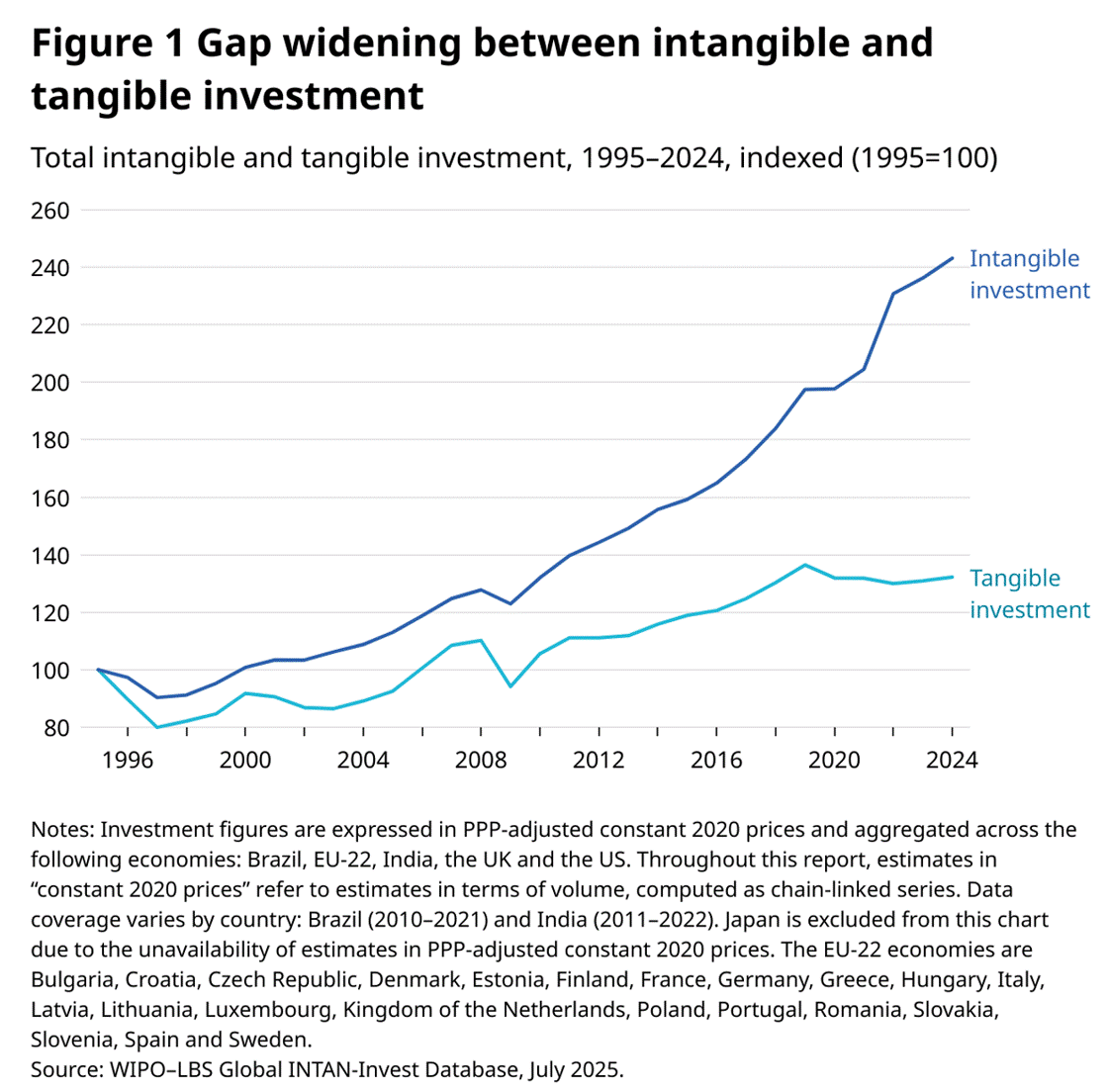
So what does this mean for Budget 2025? Put simply, now is an opportunity for Canada to course correct.
Companies across different sectors and geographies invest in different intangible assets – it patents, data, brands, copyright – for all kinds of reasons that are specific to their businesses. But what those reasons all really boil down to is that companies invest when they expect that the investment to make money.
Canadian policymakers — and much of the private sector — have been watching global markets send a clear signal for nearly a generation now that intangible assets have the biggest potential to create value, and yet Canadians have not done enough to act on that transformation. A useful Statistics Canada paper last year pointed out that sluggish investment in intangibles is a big contributor to our productivity and growth divergence with the United States.
In the U.S., having an IP strategy is table stakes for essentially any company right from the beginning, because today’s innovation economy was essentially invented in the U.S. and is reinforced by American-made rules (such as big, multilateral trade agreements).
Best practices from well-run American companies spill outwards. Investors and founders of companies are savvy as to why IP management matters, creating a virtuous cycle – Americans set the rules and learn how best to play within them. And despite the free-market trappings of the American system, the U.S. government has its thumb on the scale for its domestic tech champions in all kinds of ways.
Correctly, the U.S. government sees American companies as critical extensions of state power, influence and prestige in their geopolitical competition with China. They said as much very directly in their recent National Security Strategy.
Canada does not benefit from these same advantages, and small, early-stage companies often treat IP as an afterthought. And by the time they come to realize the importance of intangible assets, it might be too late. The assets you need to guarantee your own freedom to operate might be in someone else’s hands.
Canada has a structural weakness with two distinct elements. Our economy has a lot of small companies that mostly do not have the education and knowledge about IP they need to make smart early investments that can guarantee freedom to operate, and we’re facing strong bases of patents and other assets in other countries that make finding competitive niches challenging. Together, IP education and IP pooling can help overcome these weaknesses.
Smaller economies – Taiwan, South Korea, and Israel, to pick a few examples – have been quite effective in doing this, and were very deliberate in using policy to do it. Korea, for example, has set up sovereign patent funds to help protect Korean freedom to operate.
Canada has already dabbled in education and patent pooling functions at the federal level – this is what the Budget 2025 investments are building on.
But we have an opportunity to get more value out of these programs and allow for truly strategic scale by bringing the education and patent pooling functions under a single roof, as well as management of IP arising from federal research.
In-house federal R&D is a roughly $3 billion annual spend, which is pretty significant when you compare that figure to the approximately $4 billion to $4.5 billion spent through the Scientific Research and Experimental Development tax credit program and the federal research granting councils each year.
IP education programming is currently a little scattershot. The Innovation Asset Collective is a useful tool as a patent pool, but too limited in its current mandate (as-is, the IAC can only acquire cleantech patents). And we have nothing in place like the U.S. Bayh-Dole and Stevenson-Wydler Acts that allow for effective and widely-understood rules for commercialization of federal in-house and funded research.
The announced performance review of IP policy should look at all of these elements, and hopefully come to the conclusion that putting these important functions together can help correct Canada’s dangerous underinvestment into intangibles and IP. Council of Canadian Innovators
*******************************************************************************************************************************
Canada’s economy, business investment and employment are stifled by red tape and regulatory burden
Canada’s economy is 1.7 percent smaller, business investment is nine percent lower, and employment is 1.3 percent weaker than it should be – all due to Canada’s regulatory burden, according to a report by the Business Council of Canada (BCC).
Canada’s regulatory burden is growing fast – up 37 percent since 2006 (41 percent in the manufacturing sector) and now exceeding 321,000 requirements, the report said.
“The economic cost is undeniable,” said Stefane Marion, chief economist at the National Bank.
Overlap and duplication are rampant – multiple regulators and jurisdictions create confusion, uncertainty and cost, the report noted.
Businesses rank regulation as the No. 1 barrier to investment – even ahead of concerns about Canada-U.S. trade.
“There is a delicate balance between safeguarding and stifling citizens’ wellbeing. Regulations come with a cost, and in Canada’s case, the cost is our economic growth and future,” the report said.
Canadian businesses call the tangle of red tape they encounter “pancaking.” One regulation is stacked upon another, and another, layered into a convoluted smorgasbord of process that takes a room full of lawyers and millions of dollars to sort through, according to the report.
In a recent economic outlook, policy analysts at law firm Bennett Jones wrote about the urgency to curtail the regulatory burden as the federal government pursues its ambition to advance the Canadian economy.
“It is largely the market, not governments, that will drive the development of trade corridors, expand and diversify markets, or develop the best AI applications,” they wrote. “The first task of governments is to establish a predictable, competitive environment for investment and to remove the regulatory obstacles that serve no demonstrable and compelling policy interest.”
According to the BCC’s report, some analyses group the complaints into themes, including:
- convoluted taxes.
- vague or ambiguous requirements.
- long delays in processing paperwork.
- overlap and duplication between governments, and between government departments.
- contradictions between jurisdictions.
- permits for minor adjustments.
- risk-averse regulators and rules that may have made sense in another era but are no longer relevant.
- and many more.
In 2018, the University of Ottawa used artificial intelligence to scan through the text of 3,196 regulations to detect archaic language, overlap and convoluted rules. The analysis was led by Prof. Wolfgang Alschner from the Faculty of Law and prepared for the Canada School of Public Service.
The result was a ranking of regulations by variable – which could be useful for slashers of red tape if the work were done across all regulations in all jurisdictions in real time, the BCC report said.
The 2024 Fall Economic Statement proposed standing up a Red Tape Reduction Office using $28 million in existing Treasury Board funds. The new office would accelerate the cutting of red tape, track their work, and engage more closely with businesses – especially in telecommunications, transportation, power generation, innovation, medicine and health.
But the new office is still a work in progress.
More recently, National Bank CEO Laurent Ferreira, a member of the board of the Business Council of Canada, called for a non-partisan head of deregulation to identify and recommend removal of counter-productive red tape, as a pre-requisite to building up Canada’s competitive advantages.
Each sector had a dramatically different list of the most burdensome regulations, according to the BCC’s report. Some key areas include:
- Permitting for infrastructure projects:
Canada has struggled for decades to efficiently approve major projects vital to the country’s economic success.
Permitting remains overly complex, time consuming and is a major impediment for attracting investment in Canada. A recent report by S&P Global found that Canada’s process for mining projects – from discovery to production – ranks amongst the longest in the world at roughly 20 years.
[Editor’s note: The Carney government’s Major Projects Office aims to streamline permitting for projects identified as being in the national interest. The federal government also has recently signed agreements with several provinces, including Ontario British Columbia, New Brunswick, Manitoba, and Prince Edward Island, to use an integrated “one project, one review” approach to project assessment, including joint environmental reviews].
- Financial services complexity:
Banks and insurance companies answer to several different regulators – the Office of the Superintendent of Financial Institutions, the Department of Finance, the Financial Consumer Agency of Canada, the Canadian Deposit Insurance Corp., Fintrac and in some cases provincial overseers and securities regulators.
The Bank Act and other legislation are reviewed regularly, and regulations are in constant flux to reflect global standards on capital requirements, climate disclosure, changing technology, cybersecurity and risk management.
But the constant flux is both too slow to allow firms to keep up with global competition and trends, and too cumbersome and convoluted for compliance staff to stay on top of. Compliance with rigid rules and overlapping agencies slows down the pace of business and can inhibit modernization.
- Package labels:
There are multiple and increasing requirements for labels on packaged goods, and every change creates a cascade of compliance costs. Setting up teams to test and execute new requirements is especially costly for food and cosmetic companies.
Currently, the Competition Act, the Consumer Packaging and Labelling Act, the Food and Drugs Act and Regulations, as well as provincial laws and regulations like Quebec’s Charter of the French Language dictate regulations on labelling. Both the Competition and Consumer Packaging and Labelling Acts are used to enforce and regulate misleading label claims.
- Global minimum tax:
Global minimum taxes (GMT) aim to ensure that global corporations pay a minimum level of tax regardless of where they operate, aiming to dissuade companies from shifting to low-tax jurisdictions to evade payments. The Organisation for Economic Co-operation and Development (OECD) has led efforts to harmonize global minimum taxes, with mixed results.
The most recent proposal included two pillars. The first pillar re-allocates the profits from the largest multinationals from where they earn income to where they sell their products and services. The second pillar imposes a 15-percent tax on global corporate profits in each jurisdiction in which they operate.
In 2024, the Government of Canada introduced the Global Minimum Tax Act (GMTA) to implement Pillar Two of the OECD framework. Rather than adjusting Canada’s Corporate Income Tax, the GMTA is an additional system of taxation on corporate income.
More recently, Canada is being put at a disadvantage by implementing the GMTA even as the G7 agreed to exempt American companies from global minimum taxes. The discrepancy effectively gives American companies a large advantage at the expense of Canadian and international multinationals – all while Canada’s economy suffers from underinvestment.
- Regulatory impact statements:
If federally regulated companies want to ask for a tweak to an existing rule, the Treasury Board frequently requires them to contribute to a formal proposal that must eventually work its way through cabinet. The process often takes 18 months, even for the most mundane of changes.
Such regulatory impact analysis statements (RIAS) are required for new rules and regulations, as well as variances to existing regulations.
But companies often find that the process is a rubber-stamping exercise that merely confirms, over the course of many months, a policy direction that was already entrenched.
For federally regulated companies, especially those in financial services or telecommunications, the RIAS timelines can overlap with other regulatory processes, making for a convoluted process.
- Foreign worker permits:
Canadian businesses often use the Temporary Foreign Worker Program to fill labour shortages in their operations. However, the regulations around the program have not kept pace with changing circumstances.
More specifically, the length of processing is increasing with some migrants already in Canada losing status due to backlogs. There are significant delays at Service Canada which have extended the processing times for Labour Market Impact Assessments (LMIAs) required for the renewal of most temporary foreign worker permits. Processing times for LMIAs have surged: the average processing time is 60 business days in 2025 compared to 31 to 34 business days in 2021.
Then, once the LMIA has been processed, companies apply for work permits – another process that can take weeks or months depending on the country of origin.
For many businesses, taking part in the program requires a level of expertise in immigration policy that some companies and industries simply do not have.
- Privacy patchwork:
In 2019, the Government of Canada created a Digital Charter to protect digital information. However, the Charter was not legally binding or enshrined in legislation. Since then, there have been attempts to modernize privacy laws at the federal and provincial levels without cohesive policy coordination.
Provinces have moved forward with their own privacy legislation. In some cases, these measures apply to the private sector instead of federal laws, including in Alberta, British Columbia and Quebec.
Other provinces have health-related privacy laws similar to federal ones; these include Ontario, New Brunswick, Newfoundland and Labrador, and Nova Scotia. Alberta and British Columbia also have specific privacy laws related to employment.
Having both federal and provincial privacy regulations increases the costs of operating and expanding operations in Canada. Firms must choose between maintaining different privacy policies for individual provinces or picking one policy that meets the highest standard. This patchwork of policies incentivizes companies to leave smaller jurisdictions with tighter regulations.
The solution is to create one comprehensive framework for privacy. Some lessons learned from previous federal privacy law proposals include providing clarity in reporting requirements, interoperability with international standards, and flexibility for companies to adapt to privacy standards.
- Paid leave days:
Federal paid sick days were mandated in a rush during the pandemic, and don’t always make sense for every sector.
The rules from legislation passed in December 2022 stipulate that any continuously employed worker in a federal regulated workplace must have access to 10 days of annual paid leave to deal with illness, injury, organ donation, medical appointments or quarantine. Employers foot the bill.
Employers may request a doctor’s note after five days of absence, with the request made no later than 15 days after the employee’s return to work.
Some employers find that the rules are too rigid. Some companies say they don’t take into account human resources systems that combine sick leave, personal days and vacation nor do they allow for the nuances of demand for labour.
To add to the complexity, the federal rules often don’t align with provincial requirements. British Columbia mandates five days, for example, and Ontario requires three days.
- Building permits:
It takes nearly 250 days on average to get a building permit in Canada – three times longer than in the U.S., despite widespread consensus on the need to build faster across Canada.
A study published by the Canadian Federation of Independent Business evaluated the permitting process of renovating a bathroom in 12 different municipalities. On average, seven documents are required for a $20,000-bathroom renovation project. The long lead times for permits (often measured in years rather than weeks or months) increase housing costs at a time when housing affordability is a national concern.
The combined cost associated with permitting required for a simple renovation (such as building, plumbing, and electrical permits) ranges from $180 in Charlottetown to $2,029 in Vancouver.
Building codes were created with the intention of setting minimum standards. There are 374 proposed code changes for the National Model Construction Codes for 2025, and 186 out of 1,200 standard references are being updated in 2025.
Even when businesses comply with baseline compliance codes, they often demand the latest – and most expensive – technologies.
There are demands to reform the National Building Code to enable more housing construction. Standardizing building codes across jurisdictions would reduce complexity and risks for developers and potentially enable homebuilders to operate at larger scales.
A study by the Canadian Homebuilder’s Association found that in 2024 municipal fees on new residential developments went up by an average of $3,000 for a high-rise home since 2022, raising the new average in Canada at the time of the 2024 study to $35,000.
Overall, the extra costs and delays discourage investment in housing. From March to April 2025, the total value of building permits issued in Canada decreased by $829.6 million (-6.6 percent) to $11.7 billion.
- Different regimes for ESG reporting:
There are multiple and overlapping Environment, Social and Governance (ESG) frameworks in Canada including provincial, federal and sectoral. The BCC’s report identified six federal regimes for ESG in Canada compared to four in the United States and five in the EU. While many of these standards are voluntary, many of the regulators mention these guidelines as a pathway to mandatory reporting.
ESG standards are beneficial; some studies show implementing ESG correlated with increased profitability in Canadian businesses. However, complying with multiple and overlapping ESG requirements is not efficient nor is it cheap, with companies often obliged to staff up and contract specialists, external experts and auditors to meet requirements driven by numerous reporting requirements. Business Council of Canada
[Editor’s note: This report on the BCC’s website included several more hyperlink references].
*****************************************************************************************************************************
Canada’s approach to regulation requires modernization, including a shift to voluntary, consensus-based standards
Canada’s approach to regulation hasn’t kept up in the fast-paced age of digital technologies and the country urgently needs regulatory modernization, says independent Senator Colin Deacon from Nova Scotia.
Canada should shift to using voluntary, consensus-based standards as the foundation of its regulatory system, Deacon said in a LinkedIn post.
“Standards are what make products in our cars, houses, planes, etc. safe and interoperable, and they contribute to up to 28 percent of global GDP growth, but not in Canada,” he said.
Standardization activity is significantly and positively associated with the growth of labour productivity, according to a 2021 study by the Standards Council of Canada.
A one-percent growth in the annual stock of standards is associated with a 0.056-percent increase in labour productivity, the study found.
Over the time frame of the study (1981 to 2019), standardization is associated with 38.4 percent of the growth of labour productivity and 17.4 percent of the growth of GDP in Canada.
In 2019 alone, growth in standardization contributed up to $5.86 billion of Canada’s total increase in GDP, which was $33.7 billion.
According to the Organisation for Economic Development and Cooperation’s Product Market Regulations indicators, Canada ranks 35th out of 38 member countries in terms of regulatory burden. A lower value represents a more competition-friendly regulatory regime.
As the number of regulations grow, “they limit growth in business investment, employment and the economy – with no demonstrable improvement in public safety,” Deacon said.
“We need a different way to keep Canadians safe while encouraging made-in-Canada competition and business investment,” he said.
Regulatory modernization is key to delivering on Prime Minister Mark Carney’s election promise that “we can give ourselves more than Trump can ever take away,” Deacon said.
Canada’s regulators are mishandling the strategic value of standards, federally and sub-nationally, and that’s threatening the country’s economic resilience and prosperity, Deacon and Ryan Manucha, an expert on interprovincial trade and C. D. Howe Institute research fellow, wrote in a recent op-ed in The Globe and Mail.
Prior to Confederation, they said, Canada’s colonies had different standards for the distances between railway tracks. In Upper and Lower Canada it was 5 feet 6 inches, and in the Maritimes it was 4 feet 8½ inches.
As a result, freight and passengers had to be offloaded and reloaded at intercolonial junctions. Interprovincial standardization enabled interoperability and brought immense savings and productivity gains.
The problem since is that each jurisdiction created and entrenched trade barriers because they each developed their own version of regulations, rather than relying on consensus-based standards, Deacon and Manucha said.
Standards drive innovation by capturing and disseminating cutting-edge technology and know-how, they said.
They facilitate internal (and international) trade by enabling interoperability (think of the global alignment on USB-C connectors). And they promote economic exchange by providing credible signals of quality that reassure buyers.
“Canada cannot hope to be at the vanguard of global innovation, nor fuel its prosperity ambitions, with the way we regulate today,” they said. “Canada desperately needs a more agile, efficient and effective regulatory system.”
The shift can start with two simple tweaks to Canada’s standards system.
The first is a much-needed update to the federal rulebook for making rules: the Statutory Instruments Act (SIA). This law guides the creation of regulations. It should be changed to make explicit that compliance with consensus-based standards will be how Ottawa will enforce compliance with legislation, Deacon and Manucha said.
“The simple truth is that standards advance much faster than any one government’s regulators can keep up.”
The Europeans embraced this concept as far back as the 1980s. The Americans did it in the 1990s. Ontario did it in 2020 with its push for regulatory modernization.
“This simple legislative change keeps Canada competitive without sacrificing safety or the environment,” they said. “It leverages the trusted, expert-driven process behind Canada’s standards system and allows Canada to keep pace with the rest of the world.”
An amendment to the SIA would be accompanied by companion changes to certain cabinet and Treasury Board directives.
The second change is a modernization of Canada’s standards development institutions. “Canada’s standards ecosystem has not kept up with global best practices.”
The Standards Council of Canada (SCC), a federal Crown corporation, oversees Canada’s standardization system. But it has a conflict of interest between its for-profit and not-for-profit arms, Deacon and Manucha said.
The SCC oversees standards development (not-for profit) and sells accreditation services (for-profit). “More simply: It sets the rules of the game and then charges you to check if you’re playing by them. Overhauling the SCC by stripping out its for-profit function would bring Canada in line with modern models in Australia, Britain and the United States.”
Canada’s approach to standardization could have an outsized impact on our future prosperity, and it would only take a few modest modernizations to get us on that track, Deacon and Manucha said.
“As we work to strengthen our economic outlook and break down internal barriers, these modernizations will create a solid foundation.” Colin Deacon on LinkedIn
******************************************************************************************************************************
Canada needs a National Space Council and increased innovation support for Canadian space companies
The federal government should establish the National Space Council, chaired by the Prime Minister, to develop and orchestrate strategic space policy, directives, and to coordinate space priorities across the Government of Canada (defence, civil, commercial), according to a position paper report by Space Canada.
The National Space Council should be the forum for coordinating strategies for civil space, defence space, and commercial space capability development, and for integration into the Government of Canada’s space enterprise, the paper said. This includes domestic capability development activities and supporting export growth priorities.
Canada has been supportive of space innovation through investment programs like the Strategic Innovation Fund, through postsecondary research investment, and by providing incentive programs to startups and small/medium enterprises that are developing innovative new solutions for space, the report said. These programs have been useful in expanding innovation.
“Keeping pace with the global market and the rate of new technology development now requires a broader, more ambitious commitment. Greater policy support and coordination are required to maximize the benefits to Canada from Canada’s space industrial base.”
The report recommended that the federal government expand space-specific defence innovation programming with increased or dedicated funding to enable Canada’s space innovators to work directly with the Department of National Defence to turn great ideas into operational solutions. This will support Canada’s commitment to continental defence, and defence space capabilities more broadly.
“Global competition in space is fierce and Canada risks missing the opportunity to fully participate in the highly strategic new global space economy,” the report said.
Developing solutions in Canada gives Canada priority access to innovation, sustains Canada’s technological advantage over potential adversaries, and has the potential to deliver dual-use spin-off technologies for commercial export growth and increases opportunities for partnership with Canada’s allies and partners, according to the report.
The federal government should also accelerate the timeline for the definition and implementation of all identified existing space programs as part of the defence strategic policy update, the report recommended.
Ottawa needs to create dedicated policies for defence space innovators, including mechanisms for the commercial procurement of defence space capabilities from Canada’s space innovators, the report said.
Based on the existing timetables, there is no progress planned for 2023 or 2024 for any satellite communications programs, for example, with deployment not beginning until the 2030s, the report noted.
“These timelines are simply too long to address renewed state-based threats, and to keep pace with new space technologies being developed and fielded by innovative Canadian space companies and by potential adversaries.”
The report recommended the federal government engage directly with Canada’s space innovators to allow industry to better understand the government’s defence priorities, and to showcase Canadian industry’s R&D and technology development programs that can support the modernization of continental defence.
This includes the development of brand-new systems and the integration of commercial solutions for continental defence and upgrading legacy systems.
Space systems and solutions are an essential part of Canada’s defence strategy, contributing directly or indirectly to virtually all defence operations, the report said.
Space capabilities connect Canada’s personnel when operating at home and around the world; they provide intelligence and information vital to decision-making; and allow Canada to contribute to the collective defence of North America and internationally with our NATO and other allies.
“Prioritizing investment in defence space programs, therefore, is a part of the entire security and defence portfolio,” the report said. Space Canada
******************************************************************************************************************************
Canadian scientists made global contributions to life-saving COVID-19 vaccines and safer, more effective cervical cancer screening
Canadian scientists made global contributions to the life-saving COVID-19 vaccines as well as more effective screening for cervical cancer, researchers said at a Walrus Talks Innovation Nation webcast presented by Universities Canada.
Canadians became aware of the science of genomics during the COVID pandemic, as scientists sequenced viral genomes, said Dr. Catalina Lopez-Correa, chief global strategy officer at Genome Canada.
“Highly effective vaccines were developed and validated in less than one year,” she said.
Canada played a critical role in developing the lipid nanoparticles that delivered mRNA molecules into cells, she noted.
Dr. Pieter Cullis and his team at the at the University of British Columbia are widely recognized for pioneering the lipid nanoparticle technology that acts as the protective bubble – or “delivery truck” for mRNA, making vaccines like those for COVID-19 possible.
It was a breakthrough stemming from decades of work on drug delivery, particularly for cancer therapies.
Cancer treatment is changing today because of genomics, said Lopez-Correa, whose own treatment for breast cancer was guided by genomic tests.
“We’re entering on an era where health care is profoundly personal, where our diagnosis, our treatment and even our ability to prevent diseases can be guided by our own genetic blueprint,” she said.
However, Lopez-Correa added: “We need to make precision medicine accessible to everyone.”
Women still face inequities in health care, particularly in the prevention of diseases, said Dr. Gina Ogilvie, professor and Canada Research Chair in the Faculty of Medicine and associate director of the Women’s Health Research Institute at the University of British Columbia.
Researchers determined that cervical cancer was caused by the human papilloma virus (HPV), but a safer and more effective screening tool than the PAP smear was needed to test for pre-cervical cancer, she said.
In 2006, Ogilvie’s research applied to the Canadian Institutes of Health Research and received funding to lead the landmark HPV Focal trial to answer the question: Was HPV testing better than PAP smears for detecting cervical pre-cancer and ultimately preventing cervical cancer?
Between 2008 and 2012, the research team recruited over 25,000 women through family physicians and primary care centres in B.C.’s Lower Mainland.
The team randomized each woman to receive either HPV testing or PAP smears for cervical screening. The continued to follow these women for almost two decades.
When the team published its findings in 2018 in JAMA Network, the results of the HPV Focal trial were unambiguous, Ogilvie said. “HPV primary testing for cervical screening offered vastly improved protection against cervical pre-cancers compared with PAP smears.”
The study showed that if woman was HPV-negative, she was highly unlikely to develop cervical pre-cancer.
Ogilvie’s team also showed that screening for HPV every four to five years was safer and more effective than PAP screening every two years.
“We can test vaginal samples with HPV and we don’t need to sample from the cervix,” she noted. “And women can collect the samples themselves. There’s no need for them to undergo a pelvic exam.”
Ogilvie’s team is now examining the impact of HPV testing two years out.
“HPV testing is now recommended instead of pap smears for cervical cancer prevention globally,” Ogilvie said. “The HPV Focal Trial has been foundational in those recommendations.”
B.C., Ontario, Quebec and Prince Edward Island have already moved from PAP screening to HPV testing.
Most provinces are enroute to making this transformative change in one of their largest screening programs and embedding self-collection of samples as part of that option, Ogilvie said.
“Every female in Canada will be directly impacted by this study as cervix screening is transformed, and every Canadian will benefit as they improve the health and well-being of the women in their lives,” she said.
Ogilvie’s team’s study funded by Canadian Institutes of Health Research is one of only four studies worldwide that provided the highest level of evidence to justify this transition in screening for pre-cervical cancer. The Walrus Talks Innovation
THE GRAPEVINE – News about people, institutions and communities
Université de Montréal medical professor Nabil G. Seidah, director of the Biochemical Neuroendocrinology Research Unit of the Institut de recherches cliniques de Montréal, was awarded the 2025 Great Arab Minds Award, in the Medicine category. Granted by the United Arab Emirates, the award honours major contributions to science on an international scale and, in Seidah's case, the exceptional impact of his work on cardiovascular health and lipid metabolism. A pioneer in the discovery of the PCSK9 protein, the Egyptian-born scientist paved the way for a new generation of drugs – the PCSK9 inhibitors – now widely used to lower LDL cholesterol and prevent cardiovascular disease. His research, which includes more than 800 publications, has also advanced understanding of conditions such as fatty liver disease, dyslipidemia, obesity, inflammation, certain cancers and their metastases, and viral entry mechanisms into cells, contributing to major therapeutic breakthroughs. Université de Montréal
David MacNaughton, Canada’s former ambassador (from 2016 to 2019) to the United States, has joined CIBC as a strategic advisor. In this role, he will further strengthen CIBC's recently established Office of the CEO by providing insights to senior business leaders across areas including public policy, regulatory developments and stakeholder relations. He will also work alongside the bank's experienced group of vice-chairs. CIBC’s announcement doesn’t mention MacNaughton’s post-diplomacy stint as president of Palantir Technologies Canada, during which the federal ethics commissioner found he violated conflict-of-interest rules by offering the data-mining company’s services to the federal government as part of its response to the COVID-19 pandemic. CIBC
Dr. Yani Ioannou, PhD, an assistant professor and Schulich research chair in the Department of Electrical and Software Engineering at the University of Calgary’s (UCalgary) Schulich School of Engineering, is leading a new Canada-France research collaboration to improve generative AI models. Ioannou will partner with Dr. Umut Simsekli, PhD, from the National Institute for Research in Digital Science and Technology (INRIA) and the École Normale Supérieure in Paris. While techniques exist to compress small AI models for faster operation, they do not work well with today’s large models. The research team will investigate why large models are difficult to compress. By understanding what happens inside these systems during model training, the team aims to design new approaches that reduce energy use, cost and environmental impact without sacrificing performance. The project is jointly funded by the Natural Sciences and Engineering Research Council of Canada and France’s National Research Agency. UCalgary
Ottawa-based Kinaxis Inc., a developer of supply chain tools, announced the appointment of American software executive Razat Gaurav as CEO effective January 12, 2026. Gaurav has an established track record of building and scaling global organizations in high-growth markets. He was the former CEO of both Planview and LLamasoft and previously held senior roles at Blue Yonder and i2 Technologies. Gaurav succeeds John Sicard, who stepped down as Kinaxis CEO at the end of 2024 amid a shareholder activism campaign to sell off the firm. Kinaxis
United Conservative Party MLA Rebecca Schulz resigned from Alberta’s cabinet, where she was serving as Minister of Environment and Protected Areas since 2023. She will remain the MLA for Calgary-Shaw only until May 2026. Schulz said the decision was about timing and pursuing new career opportunities. Her departure has fuelled speculation that Premier Danielle Smith may call an early provincial election, though Alberta’s fixed election date is in 2027. Smith thanked Schulz for her service and appointed Grant Hunter, MLA for Taber-Warner and associate minister for water, as the new environment minister, with Justin Wright, MLA for Cypress-Medicine Hat, becoming chief government whip. Govt. of Alberta
The University of Ottawa’s board of governors announced the appointment of François Guimont as its new chair, for a term running from January 1, 2026 to June 30, 2029. Guimont is currently vice-chair of the board and succeeds Jennifer Adams, who has served as chair since 2021. For more than 34 years, Guimont served in the federal government, where he held several senior leadership positions, most notably as deputy minister of Public Safety and deputy minister of Public Works and Government Services. University of Ottawa
Erin Flanagan, an executive at PSP Investments who helped set up the Canada Growth Fund, is taking leave from that post to work for Michael Sabia, Clerk of the Privy Council, Secretary to Cabinet, and head of the federal public service. Sabia was instrumental in creating the federal investment vehicle as deputy minister of finance. Erin Flanagan’s LinkedIn post
Queen’s University announced the reappointment of Nancy Ross as Vice-Principal (Research) for a second five-year term, effective August 1, 2026. Ross, a highly accomplished research administrator and faculty member in the Department of Public Health Sciences, first assumed the role in August 2021. Among her accomplishments during her first term was leading the development and launch of the Strategic Research Plan 2025-2030, a comprehensive roadmap for strengthening Queen’s University’s position as one of Canada’s most research-intensive institutions, and accelerating the Research Impact goal of the Queen’s Strategy. Queen’s University
The C. D. Howe Institute announced the reappointment of four policy experts as fellows-in-residence for 2026. The fellows are Steve Ambler, Gherardo Caracciolo, John Lester, and Mark Zelmer. Ambler taught at l’École des sciences de la gestion de l’Université du Québec à Montréal and chaired the Department of Economics from 2012 to 2015. Caracciolo is a lecturer for the Beedie Business School at Simon Fraser University and a former senior policy analyst at the C.D. Howe Institute. Zelmer brings more than 40 years of experience in financial sector policy and regulatory issues, having worked at the Office of the Superintendent of Financial Institutions, the Bank of Canada, and the International Monetary Fund. Lester, a former federal government economist, will also continue as an advisor to the C.D. Howe Institute’s Fiscal and Tax Competitiveness program. C. D. Howe Institute
Phil Donelson, vice-president, public policy at the Insurance Bureau of Canada, joined the advisory board of the Institute for Sustainable Finance (ISF). He brings deep experience on insurance industry resilience and sustainable finance. Also joining ISF’s advisory board is Sarah Thompson, managing director, global head of sustainable finance at RBC Capital Markets. ISF said Thompson’s long experience advancing sustainability initiatives makes her an important addition to this group of experts who have committed to driving ISF's mission and accelerating its success. ISF
*****************************************************************************************************************************
UBC researchers achieve breakthrough in producing an important type of human immune cell in the laboratory
For the first time, researchers at the University of British Columbia (UBC) have demonstrated how to reliably produce an important type of human immune cell – known as helper T cells – from stem cells in a controlled laboratory setting.
The findings, published in Cell Stem Cell, overcome a major hurdle that has limited the development, affordability and large-scale manufacturing of cell therapies. The discovery could pave the way for more accessible and effective off-the-shelf treatments for a wide range of conditions like cancer, infectious diseases, autoimmune disorders and more.
In recent years, engineered cell therapies, such as CAR-T treatments for cancer, have delivered dramatic and lifesaving results for patients with otherwise untreatable disease. These therapies work by reprogramming human immune cells to recognize and attack illness, essentially turning the cells into “living drugs.”
Despite their tremendous promise, cell therapies remain expensive, complex to produce and inaccessible to many patients worldwide. One major reason is that most current treatments are made from a patient’s own immune cells, requiring weeks of customized manufacturing for each patient.
Cell therapies for cancer work best when two types of immune cell are present: killer T cells, which directly attack infected or cancerous cells, and helper T cells, which act as the immune system’s conductors – detecting health threats, activating other immune cells and sustaining the immune responses over time.
Although progress has been made using stem cells to generate killer T cells in the lab, scientists have so far been unable to reliably produce helper T cells.
In the new study, the UBC researchers were able to solve this long-standing challenge – adjusting key biological signals during cell development to precisely control whether stem cells developed into either helper or killer T cells.
The team discovered that a developmental signal called Notch plays a critical but time-sensitive role. While Notch is needed early in immune cell development, if the signal remains active for too long, it prevents helper T cells from forming.
“By precisely tuning when and how much this signal is reduced, we were able to direct stem cells to become either helper or killer T cells,” said study co-first author and research associate Dr. Ross Jones. “We were able to do this in controlled laboratory conditions that are directly applicable in real-world biomanufacturing, which is an essential step toward turning this discovery into a viable therapy.”
Importantly, the researchers demonstrated that the lab-grown helper T cells didn’t just resemble real immune cells – they behaved like them. The cells showed markers of healthy mature cells, carried a diverse range of immune receptors and could specialize into subtypes that play distinct roles in immunity.
“This is a major step forward in our ability to develop scalable and affordable immune cell therapies,” said co-senior author Dr. Peter Zandstra, professor and director of UBC’s School of Biomedical Engineering.
“This technology now forms the foundation for testing the role of helper T cells in supporting the elimination of cancer cells and generating new types of helper T cell-derived cells, such as regulatory T cells, for clinical applications,” Zandstra said. UBC
R$




Events For Leaders in
Science, Tech, Innovation, and Policy
Discuss and learn from those in the know at our virtual and in-person events.
See Upcoming Events
You have 0 free articles remaining.
Don't miss out - start your free trial today.
Start your FREE trial Already a member? Log in
By using this website, you agree to our use of cookies. We use cookies to provide you with a great experience and to help our website run effectively in accordance with our Privacy Policy and Terms of Service.